
Flexibility Facts I Wish Every Man Over 35 Knew
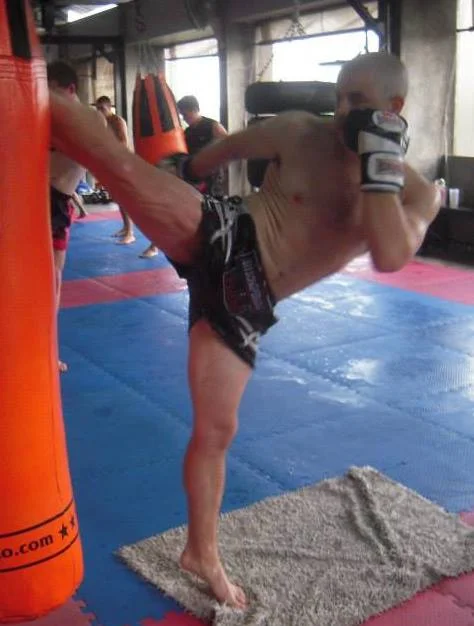
Ripping a high kick on my 32nd birthday while training at Sitsonpeenong in Thailand. 13 years later I can still do this with little to no warm up, want to know how? Keep reading below.
Men will say, “I’m not flexible,” but then, when asked, “How often do you work on it?” It’s generally crickets. This is why all my strength training and programs include intentional flexibility protocols.
First and foremost, why should you care? I always have an easier time helping a more flexible man lose weight, gain muscle, and stay less injured. This is a generalization, but men over 35 tend to be injured because they lack flexibility, women because they lack stability.
Here is the short and to the point version of this:
There are three primary forms of stretching, with some other sub-categories but this IS the TLDR version, so here we go:
Static Stretching: This is holding a stretch for an extended period of time it a primarily static position. The stretch is usually meant to progress during this period, but gradually and smoothly. Example for hamstrings: Seated Hamstring Stretch.
Dynamic Stretching: You are actively moving a limb through space while looking to increase the range of motion. The key distinction between this and the next stretch is that you control the movement in a dynamic stretch. Example for hamstrings: Kickstand Sweep.
Ballistic Stretching: This type of stretching involves using momentum to move a joint through new ranges of motion. This type of stretching is the most advanced and is best for prepping a muscle to exert high levels of force. A high-knee sprint done with concentrated effort is one of the most common examples. Example for hamstrings: Front Rising Kick.
Disclaimer
Everything below is a sample intended for a person in excellent health, with no pre-existing known or unknown conditions. User assumes all liability, but you’re smart and cool, and knew that already!
For this particular subject of athletic development I will include the added caveat that when it comes to flexibility, “more is not always better.” This can be especially true for females or anyone with hyper mobile joints.
Longer Version!
In my experience, men almost always need more flexibility, while women are usually better served by focusing on more stability. The best training protocols are a marriage of both flexibility and stability, some people define this as mobility, I like to term this as “athletic flexibility.” Much like any athletic endeavor, there are layers and levels.
Probably the biggest mistake I see men make is looking to yoga for flexibility. Most yoga, especially Hatha, will not serve someone who is not already flexible. In my experience as a strength coach, when an already inflexible man does yoga, he builds more compensation patterns instead of actual tissue tolerance. If you enjoy yoga, do it. However, I find this is rarely the case for the men I coach: you can get more done in the 15-minute protocol at the end of this article than in an hour-long yoga class (and we aren’t even including commute time).
I will go a step further and say that there are also levels to this type of “mobility marriage” with the ability to control a limb and explosively deliver force as being the highest. A powerful, precise high kick in Muay Thai is an example of this, and a deep sprawl or blast double in grappling. For the everyday person, this would be more commonly the ability to run after your kids without pulling a muscle, or bracing yourself
Because the above examples are the highest levels of “athletic flexibility,” people are often tempted to skip the foundational level of flexibility: static stretching.
Basic Stretching Protocol
At The Very Least implement some static stretching, this can best be done in a state where you are trying to relax like after class or before bed. That being said, “the best time” to get it done is a time when YOU WILL get it done. Here is a sample protocol, do each one 2 minutes a limb, except the 4th and final do 1 min a side or more. This sequence can be done ideally before bed or in a similar relaxed state.
Would you like a more advanced protocol? Send me a message at mark@sayerfit.com. If you would like me to write more on flexibility, let me know in the comments.